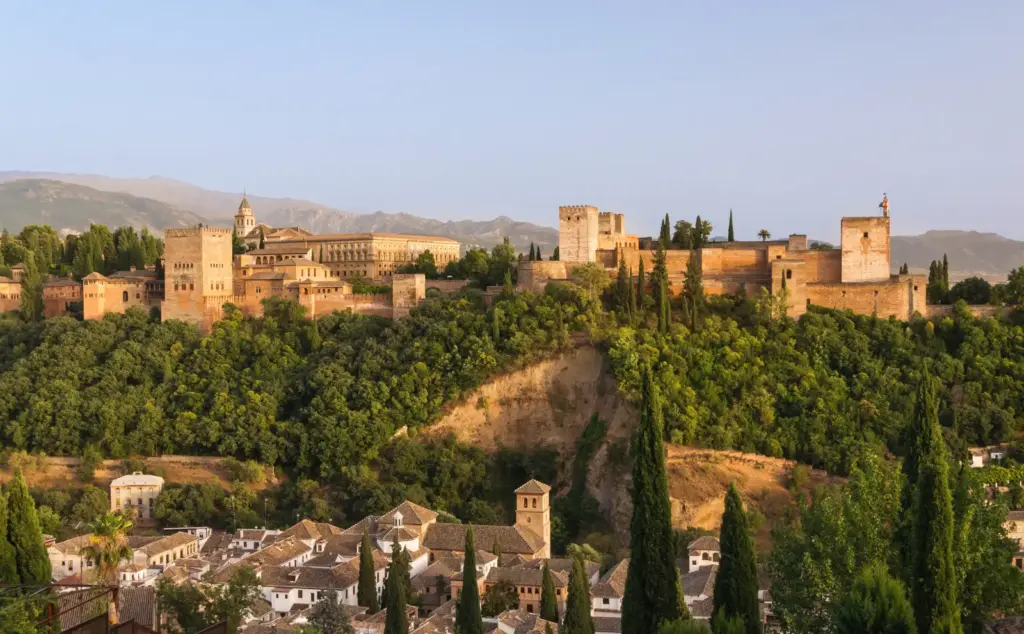
Two days is the right amount of time for a first visit to Granada: enough to see the big things without rushing, and enough to sit down for dinner, because half of what makes this city is the atmosphere. The hard part isn’t choosing what to see, it’s the order. Get the Alhambra in the wrong slot and the rest of the trip falls apart around it.
This is the itinerary I’d plan for a friend coming for the first time: rough timings, real places by name, and the hills flagged in advance.
Notice as of 15 September 2026: after the August earthquakes, the Alcazaba (including the Torre de la Vela) and the Comares Tower are still closed to the public. The rest of the Alhambra is open and ticket prices are unchanged. Before you go, check the Patronato notices or call +34 958 027 971. Full details in Alhambra tickets.
First things first: book the Alhambra
Before you think about timings, book your ticket as soon as you have dates. The Alhambra sells out weeks ahead, and in spring and autumn even earlier. If you miss out you have to rebuild the whole trip, so do this first. I walk you through the options and the official website in the guide to buying Alhambra tickets.
Two things worth knowing before you pick a time slot:
- The time on your ticket is for the Nasrid Palaces, not for entering the grounds. It’s exact, and the grace period is short (a little over half an hour). Miss it and you don’t get into the palaces at all.
- The site is huge. Alcazaba, Nasrid Palaces, Generalife and the Palace of Charles V. Allow a good three hours to see it properly, and expect slopes and steps almost the whole way.
This itinerary assumes you visit the Alhambra on the morning of day one. That’s what I’d do: you get the big visit out of the way on fresh legs and everything else falls into place.
Day 1: the Alhambra and the city centre
Morning (9:00): the Alhambra and the Generalife
Go up with time to spare. On foot from Plaza Nueva, the Cuesta de Gomérez and the woods below the walls take about twenty minutes of steady climbing. If you’d rather save your legs, the C30 and C32 minibuses leave from Plaza Isabel la Católica and drop you at the top.
An order that works: the Alcazaba first (the fortress, with the Torre de la Vela and the best views over the city), then the Nasrid Palaces at your time slot, and the Generalife last, since it’s at the far end and there’s a walk to it. In between, the Palace of Charles V, which is free to enter.
If the logistics stress you out, or you want to understand what you’re looking at, this is where a guided tour or an audio guide earns its money. Everything is broken down in what to see in the Alhambra.
Lunch (14:00): back down to the centre
Walk back down, either by the Cuesta de Gomérez or along the Paseo de los Tristes, and eat in the centre. If you fancy tapas already, Bodegas Castañeda (calle Almireceros) and Los Diamantes (calle Navas) are two classics that never let you down. If you’d rather sit down to a proper meal, there are options by neighbourhood in where to eat in Granada.
Afternoon (16:30): Royal Chapel, Cathedral and the old Nasrid city
All of this is within a few streets of each other and takes a couple of hours on foot:
- The Royal Chapel: where the Catholic Monarchs are buried. It’s small and takes half an hour. Check the opening hours for the day you go, they change with the season and it closes at midday.
- The Cathedral: right next door, huge and surprisingly bright inside.
- La Alcaicería: the old silk market, now narrow lanes of souvenir shops. Touristy, ten minutes, but it gives you the feel of it.
- El Corral del Carbón: a 14th-century Nasrid merchants’ inn, the best preserved one left. Free to enter, almost always empty, a five-minute stop that nearly everyone walks straight past.
- La Madraza: the old Nasrid university, opposite the Royal Chapel.
- Plaza Bib-Rambla: flower stalls, terraces and somewhere to sit for a while.
Evening (20:30): tapas on Navas or in the Realejo
In Granada the tapa comes free with your drink, so dinner means walking from bar to bar. Calle Navas is the easy central route: Los Diamantes for fried fish, Bar Ávila and Bar Provincias for old-school tapas.
For somewhere less packed, cross into the Realejo, the old Jewish quarter: La Tana for wine, Om-Kalsum for Arab-leaning tapas. On the way you’ll run into the street murals by El Niño de las Pinturas.
There’s a full crawl with more names in the best tapas bars in Granada, and how the whole free-tapa thing works in tapas in Granada.
Day 2: Albaicín, Sacromonte and sunset
Morning (9:30): Carrera del Darro and the Albaicín
Start along the Carrera del Darro, which runs from Plaza Nueva beside the river and is one of the prettiest streets you’ll walk down anywhere. Two short, cheap stops on the way that most people skip:
- El Bañuelo: 11th-century Arab baths, with star-shaped skylights in the vaults.
- Casa de Zafra: a restored Nasrid house that also explains the history of the quarter. Go in here first and the rest of the morning makes more sense.
The street ends at the Paseo de los Tristes, with the Alhambra directly above you. From there you climb into the Albaicín. Don’t try to follow a map to the letter: the quarter is a maze and getting lost is part of the plan. Take in Plaza Larga and its Arco de las Pesas, the Colegiata del Salvador, the little square of San Miguel Bajo and the Dar al-Horra palace, home of Boabdil’s mother and never with a queue.
If you’re tight on time, going up with a free walking tour saves you the wandering.
Lunch (14:00): a carmen with a view
If there’s one day to eat with the Alhambra in front of you, it’s this one. El Mirador de Morayma and El Huerto de Juan Ranas are two cármenes (walled houses with a garden) in the Albaicín with terraces and the view. You need to book and they aren’t cheap, but you remember that lunch.
The local, half-the-price version is up in Plaza Larga: Bar Aixa and Casa Torcuato, full of neighbours and with no view at all.
Afternoon (17:00): the Sacromonte
From the Albaicín you can walk to the Sacromonte along the Camino del Sacromonte, or take the C34 minibus if your legs have had enough. This is the cave quarter and the home of Roma flamenco, and it has two stops worth your time: the Museo Cuevas del Sacromonte, which shows how people actually lived inside the caves, and the Abadía del Sacromonte, higher up and much quieter.
Sunset: the San Nicolás viewpoint
Head back into the Albaicín for sunset. The Mirador de San Nicolás is the famous one, with the Alhambra opposite and the Sierra Nevada behind it, and at that hour it’s packed with people and guitars. For the same view without the crowd, climb a bit further to the Mirador de San Cristóbal or the Mirador de San Miguel Alto, the highest and, for my money, the best of the lot.
I compare them all in the best viewpoints in Granada.
Evening: flamenco or a quiet dinner
To finish, a tablao. In the Sacromonte caves you have Cueva de la Rocío, Zambra de María la Canastera, Cuevas Los Tarantos and Venta El Gallo. If you’d rather sit properly with better sound, the centre and the Albaicín have Jardines de Zoraya and Casa del Arte Flamenco. I explain which to pick in flamenco shows in Granada.
And if flamenco isn’t your thing, dinner in the Realejo or the Albaicín works just as well. There are places in where to have dinner in Granada.
The itinerary in short
- Day 1 morning: Alhambra and Generalife (a good three hours).
- Day 1 afternoon: Royal Chapel, Cathedral, Alcaicería, Corral del Carbón and Bib-Rambla.
- Day 1 evening: tapas on Navas or in the Realejo.
- Day 2 morning: Carrera del Darro, El Bañuelo, Casa de Zafra and the Albaicín.
- Day 2 afternoon: Sacromonte, then sunset at a viewpoint.
- Day 2 evening: flamenco in a cave or dinner in the Realejo.
Getting around in two days
- On foot, almost all of it. The centre is small and you’ll cross it ten times.
- The minibuses save you the hills: C30 and C32 to the Alhambra, C31 and C32 to the Albaicín, C34 to the Sacromonte. They’re tiny, they’re always full, and they’re worth every cent after six hours on your feet.
- Not by car. The centre is a restricted-traffic zone and the Albaicín is impossible. If you drive here, leave it in a car park and forget about it for two days.
- Comfortable shoes, seriously. Granada is all slopes and cobbles, and the local paving gets slippery in the rain.
Where to stay for a two-day trip
With only two days, the area matters more than the hotel. Stay in the centre (between Plaza Nueva, the Cathedral and Puerta Real) and everything is walkable. The Albaicín is beautiful to sleep in, but it means hills with a suitcase, and on a two-day trip you pay for that in time.
I go through it area by area in where to stay in Granada, with specific options in hotels in the city centre.
Variations depending on when you arrive
- If you arrive at midday on day one: do the centre that afternoon, the Alhambra on the second morning and the Albaicín that afternoon. You lose the Sacromonte, which is the most expendable of the two.
- If you’re travelling with children: cut monuments and build in a break at midday. There’s an adapted plan in Granada with kids.
- If it rains on one of the days: the Albaicín plan collapses. Swap it for museums, a hammam and the market, all in what to do in Granada when it rains.
- If your two days are a weekend: book the flamenco show and the restaurant with a view before you travel. More ideas in a weekend in Granada.
If you have half a day more
With a few extra hours I’d add the Monasterio de San Jerónimo or La Cartuja, both outside the usual circuit and all the better for it. And if you have a free evening, the Alhambra at night is a different ticket and a completely different city.
Have fewer days, or more? I’ve written the same kind of itinerary for Granada in one day and Granada in three days, plus the full list in what to see in Granada.
Frequently asked questions
What can you see in Granada in two days?
Day one, the Alhambra in the morning and the centre in the afternoon (Royal Chapel, Cathedral, Alcaicería and Corral del Carbón), with tapas on Navas in the evening. Day two, the Carrera del Darro and the Albaicín in the morning, the Sacromonte in the afternoon and sunset at a viewpoint.
Is two days enough for Granada?
Plenty for the essentials. Two days cover the Alhambra, the centre, the Albaicín and the Sacromonte without rushing. What you leave out are the museums, La Cartuja and any day trip to the coast or the Alpujarra.
Which day should I visit the Alhambra?
The morning of day one, with the ticket booked in advance. You go with rested legs and the rest of the trip organises itself around it. If you only get an afternoon slot, flip the order and do the centre in the morning.
How far in advance should I book the Alhambra?
The further the better: in high season it sells out weeks ahead. As soon as you have your travel dates, buy the ticket and build the itinerary around the time slot you’re given for the Nasrid Palaces.
Can you see Granada in two days on foot?
Yes, the whole itinerary works on foot. It’s a fair few kilometres and a lot of climbing, so for the Alhambra, the Albaicín and the Sacromonte you have the C30, C31, C32 and C34 minibuses, all leaving from the centre.
Where should I stay for two days in Granada?
In the centre, between Plaza Nueva, the Cathedral and Puerta Real. Everything is walkable and you don’t lose time getting around, which on a two-day trip is exactly what you don’t have to spare.
When is the best time to come for two days?
Spring and autumn, for the temperature and the light. July and August are very hot at midday and the Alhambra in full sun is hard work, so if you come in summer, put it first thing. Winter has fewer people and snow on the Sierra behind the city.