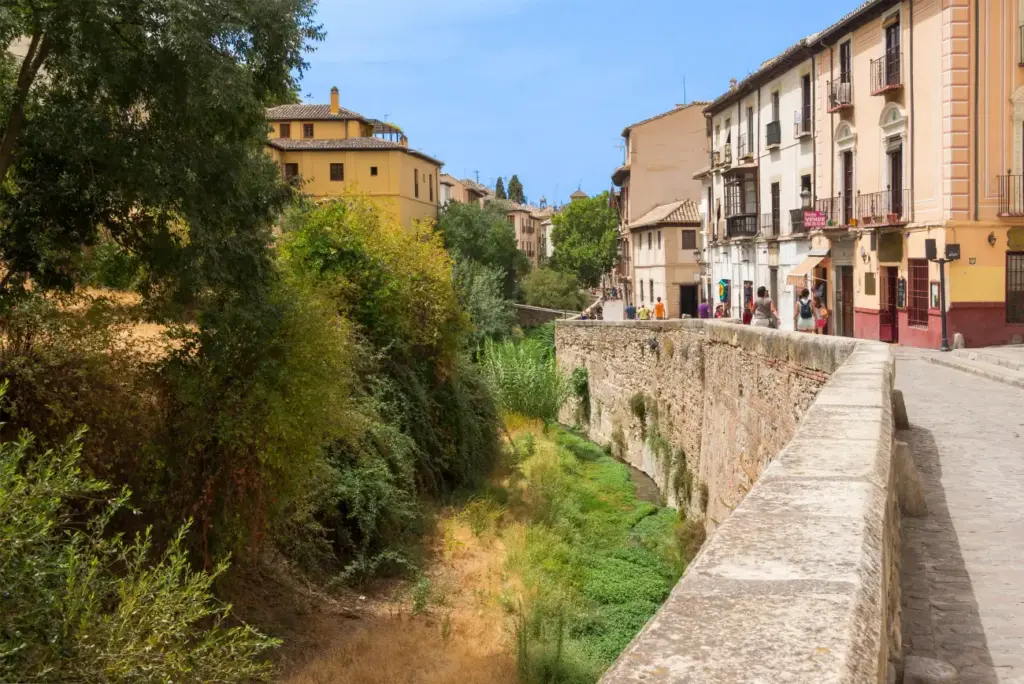
In Granada, getting the neighbourhood right changes the whole trip. This is a city of hills and narrow streets, so staying near the centre saves you taxis, cars and tired legs, and puts everything within a walk. Here’s the honest area-by-area rundown, with specific hotels and the things you only learn by living here.
Where to stay in Granada at a glance
- The centre: the most convenient and best connected. First visit? This one.
- The Albaicín: the prettiest, the best views, and the hills.
- The Realejo and calle Navas: tapas on your doorstep and proper local life.
- Next to the Alhambra: if the Alhambra is what your trip is built around.
- Outside the old town: cheaper, but you pay for it in walking and taxis.
1. The centre: the easiest choice
For a first visit I’d stay in the centre, in the triangle between Plaza Nueva, the Cathedral and Puerta Real. Everything is walkable from there: the Royal Chapel, the tapas streets, the climb up to the Albaicín and the minibuses to the Alhambra.
Places that are exactly where you want them:
- Hotel Macià Plaza, right on Plaza Nueva. Simple, but you walk out of the door and you’re there.
- Hotel Palacio de Santa Paula, on Gran Vía: a 16th-century convent turned hotel, cloister and all. It’s one of the expensive ones and it shows.
- Room Mate Leo, on calle Mesones, in the middle of the shopping streets.
- Hotel Anacapri, on calle Joaquín Costa, two minutes from the Cathedral.
- Hotel Shine Alcaicería, on calle Zacatín, right by the old silk market.
- Hotel Reina Cristina, on calle Tablas, in the house where Federico García Lorca took refuge with the Rosales family before he was arrested in August 1936.
- Gar Anat Hotel Boutique, on Placeta de los Peregrinos near Puerta Real. It used to be a pilgrims’ inn.
- Eurostars Puerta Real, on Acera del Darro, more of a big practical hotel.
I break down the streets, what to avoid for noise and what to expect from each block in hotels in Granada city centre.
2. The Albaicín: charm, with hills attached
Sleeping in the Albaicín means waking up in the prettiest quarter in Granada, sometimes with the Alhambra framed in your window. The price is the slopes, the steps and the fact that a lot of cars simply can’t reach the door. If you travel light and like walking, it’s more than worth it. If you have big suitcases or limited mobility, stay down below.
The lower part, between the Carrera del Darro and the Cuesta de Santa Inés, is the compromise: you get the character of the quarter and you’re still five minutes from Plaza Nueva.
- Hotel Casa Morisca, on the Cuesta de la Victoria: a late 15th-century Moorish house with its courtyard and pool. This is the one I’d pick for a treat.
- Hotel Palacio de Santa Inés, on the hill of the same name, with a patio and 16th-century frescoes.
- Hotel Casa 1800, on calle Benalúa, steps from the Carrera del Darro.
- Hotel Casa del Capitel Nazarí, on Cuesta Aceituneros: a Renaissance mansion with a genuine Nasrid capital in one corner of the courtyard.
- Shine Albayzín, directly on the Carrera del Darro.
- Hotel Mirador del Jazmín, on Placeta Porras, higher up and quieter.
One practical tip: if you book in the upper Albaicín, email the hotel and ask how to arrive with luggage. They all have their trick (a taxi that can make it up, a meeting point), and it saves you the first hour of your holiday dragging a suitcase over cobbles.
3. The Realejo and calle Navas: atmosphere and tapas
The Realejo, the old Jewish quarter, is what I recommend if you want neighbourhood life and tapas on your doorstep without paying Plaza Nueva prices. And calle Navas, which forms the border with the centre, is the easiest tapas crawl in the city.
- Hotel Palacio de los Navas, at number 1: a 16th-century mansion that was once the city mint.
- Hotel Navas, on the same street, simpler and very well placed.
- Hostal Navas 14, if you want something cheap without leaving the action.
The catch, and it matters: Navas is a bar street until late. If you’re a light sleeper, ask for an interior room or one facing the courtyard. With that sorted, you have the tapas right outside.
4. Next to the Alhambra
If your trip revolves around the Alhambra, staying on the hill saves you the early start and the morning taxi:
- The Parador de Granada is inside the Alhambra grounds, in the old convent of San Francisco. It’s expensive and books out far ahead, but staying there means having the place to yourself once the gates close.
- Hotel Alhambra Palace, on the way up: a neo-Nasrid building from 1910 with a terrace looking over the whole city. You can go up for a drink even if you’re not staying.
One thing to weigh up: sleeping up there is convenient for the Alhambra and slightly inconvenient for everything else. Every dinner or evening stroll in the centre means going down and climbing back up. On a two-day trip the centre usually wins. And remember the ticket has to be booked separately, your hotel doesn’t provide it.
5. Staying in Granada on a budget
Granada is affordable compared with Seville or Málaga, and thanks to the university it has a genuinely good hostel scene. Oasis Backpackers, White Nest and Makuto Guesthouse are all in the old town and all of the sociable sort.
They’re compared in hostels in Granada, and the well-located cheap hotels are in budget hotels in Granada.
6. If you’re splashing out: palaces and cármenes
If you’re here to celebrate something, Granada has historic buildings turned into hotels that are half the experience:
- Hospes Palacio de los Patos, a listed 19th-century mansion on Solarillo de Gracia, with a spa.
- Hotel Villa Oniria, another 19th-century townhouse, between the centre and Puerta Real.
- Hotel Palacio de Santa Paula, the Gran Vía convent mentioned above.
- And in the Albaicín, Hotel Casa Morisca, which for me is the loveliest of the lot.
Areas I wouldn’t choose
Booking sites will show you cheap hotels on Camino de Ronda, Pedro Antonio de Alarcón, in the Zaidín or near the bus station. They’re not bad areas, they’re just outside the old town: you’re looking at a twenty or thirty minute walk, or a bus, every time you want to do anything.
If money is tight, I’d take a hostel in the centre over a three-star hotel half an hour away. On a short trip, travel time costs you more than the difference in price.
Tips for getting it right
- Book early for the big dates: Easter week, Corpus Christi (Granada’s main festival, in June), the Day of the Cross (3 May) and the spring and autumn long weekends. Everything fills up and prices jump.
- If you’re driving, check the parking before the hotel. The old town is a restricted-traffic zone and street parking is impossible. Confirm the hotel has a garage or an arrangement with one, and ask the nightly rate.
- Don’t trust distance on a map alone. Three hundred metres in Granada can be a fifteen per cent gradient. If the address contains the word cuesta, brace yourself.
- Ask about noise if you’re staying on Navas, Elvira or Pescadería, which are bar streets.
- Arriving by train or coach: the train station is a long walk from the centre and the bus station is considerably further. With luggage, take a taxi or a city bus.
So where should you stay?
- First visit, short trip: the centre, between Plaza Nueva and the Cathedral.
- Couple, city break, want it to be beautiful: lower Albaicín, near the Carrera del Darro.
- Here for the atmosphere and the food: the Realejo or calle Navas.
- Watching the budget: a hostel in the old town beats a hotel far out.
- Here mainly for the Alhambra: the Alhambra hill or the upper Realejo.
With the bed sorted, build the rest of the trip around what to see in Granada, the two-day itinerary and where to eat. Coming for a weekend? The full plan is in a weekend in Granada.
Frequently asked questions
What’s the best area to stay in Granada?
For a first visit, the centre, between Plaza Nueva, the Cathedral and Puerta Real: everything is walkable. For charm and views, the lower Albaicín. For atmosphere and tapas, the Realejo or calle Navas.
Is it worth staying in the Albaicín?
For the charm and the views, yes. Bear in mind the hills and that many cars can’t reach the door. The lower part, by the Carrera del Darro, gives you the beautiful side of the quarter without leaving you far from the centre.
Can you sleep inside the Alhambra?
Yes. The Parador de Granada sits inside the grounds, in the former convent of San Francisco. It’s expensive and needs booking well in advance, but it’s the only way to be in there after the site closes to the public.
How far in advance should I book a hotel in Granada?
As early as you can for Easter week, Corpus Christi, the Day of the Cross and long weekends. Outside those dates, two or three weeks is usually enough to find something central.
Should I come to Granada by car?
To get here, fine. To get around once you’re here, no. The old town is a restricted-traffic zone and the Albaicín is impassable. Pick a hotel with a garage, park the car and walk.
Where can I stay cheaply in Granada?
In old-town hostels like Oasis Backpackers, White Nest or Makuto Guesthouse, or in well-located budget hotels. That works out better than a cheaper hotel on Camino de Ronda or in the Zaidín, which leaves you far from everything.
How many nights do you need in Granada?
Two nights is the minimum to see the Alhambra, the centre and the Albaicín without rushing. Three gives you the Sacromonte, a museum and a short trip out to the mountains or the coast.