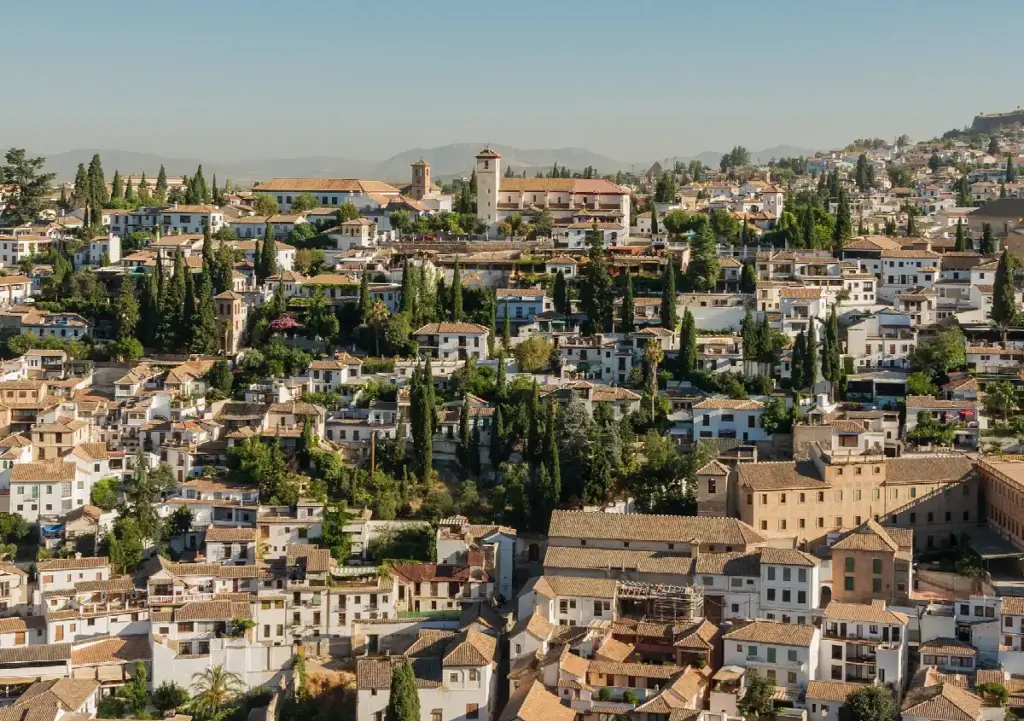
The Albaicín is my favourite neighbourhood in Granada and, if you ask me, the soul of the city. It is the old Moorish quarter: a maze of cobbled slopes, whitewashed houses and cármenes hidden behind garden walls, listed as a UNESCO World Heritage Site. Here is what to see, how to get up there without killing your legs, which viewpoints are actually worth it (there are more than San Nicolás) and the exact route I would walk with a friend visiting for the first time.
Notice as of 15 September 2026: after the August earthquakes, the Casa del Horno de Oro and the Palacio de Dar al-Horra are still closed; the Bañuelo, the Maristán and the Corral del Carbón have reopened. In the Alhambra, the Alcazaba and the Comares Tower remain closed. Full details in Alhambra tickets.
What the Albaicín is
The Albaicín is the hill where Muslim Granada settled, facing the Alhambra across the Darro river. After the city fell in 1492 it stayed the Morisco heart of Granada, which is why it kept its Arab street plan: narrow lanes with no logic at all, climbing and dropping wherever they please.
Its signature is the carmen: a house with an orchard, a garden and a view, hidden behind a plain white wall that tells you nothing from the street. You walk past dozens without noticing. That is half the charm of the place.
What to see in the Albaicín
Carrera del Darro and Paseo de los Tristes
The Carrera del Darro is the natural way in and one of the most beautiful streets in Spain. I will stand by that. It runs along the river, with its old stone bridges and the Alhambra peering over the rooftops.
It ends at the Paseo de los Tristes, the walk of the sad ones, named after the funeral processions that passed on their way to the cemetery. These days it is the opposite: terraces, people, and the best view of the Alhambra from below, with the Torre de la Vela right above you.
The Moorish monuments almost nobody visits
This is the part most people skip, and it is a shame. They are small, they are empty and each one takes twenty minutes:
- El Bañuelo (Carrera del Darro): 11th century Arab baths, among the best preserved in Spain. The star shaped skylights in the ceiling are the photo.
- Casa de Zafra: a restored Nasrid house with its courtyard and pool, which doubles as the neighbourhood interpretation centre. Start here if you want to understand the Albaicín before you walk it.
- Casa del Horno de Oro: another Moorish house with a courtyard. Tiny and quiet.
- Dar al-Horra Palace: the palace where Aixa, Boabdil’s mother, lived, right at the top of the quarter. The view from its mirador is one of the best in Granada and there is never a queue.
All four are covered by the Dobla de Oro, a combined ticket from the Alhambra trust that bundles these Albaicín monuments with the Alhambra itself. If you are visiting the Alhambra anyway, check how it works in the guide to Alhambra tickets, because it usually pays off.
Plaza Larga and the Arch of the Weights
Plaza Larga is the real neighbourhood, the one that carries on when the tourists leave. There is a morning market, old bars and neighbours having coffee. You reach it through the Arco de las Pesas, an 11th century gate in the city wall where the weights of cheating merchants were hung up for everyone to see. They say that if you touch the arch and make a wish, it comes true. I touch it every time, just in case.
Colegiata del Salvador and San Miguel Bajo
The Colegiata del Salvador was built on top of the quarter’s main mosque and still keeps its ablutions courtyard, with the arches and the water tank. A jump back in time inside a church.
A little further on you reach the placeta de San Miguel Bajo, with its church, its trees and its terraces. One of the nicest squares in Granada to sit down with a drink and be left alone.
The street of the tea houses
Calderíería Nueva is the tea house slope, with spice shops, coloured lamps and the smell of mint tea. It is very touristy, I will not pretend otherwise, but it is beautiful and sitting down for a tea with Arab pastries is still worth doing. Walk up it and you are inside the Albaicín.
The cármenes and the old wall
Almost every carmen is private, but a few open up. The Carmen de la Victoria belongs to the University of Granada and opens its gardens at set hours: terraced levels, cypresses and the Alhambra straight ahead. Others you enjoy over lunch, and I get to that below.
Up at the top, the 11th century Zirid wall is still standing, with the Puerta Monaita gate and the Aljibe del Rey, the largest cistern in the quarter. Hardly anyone makes it up here.
The viewpoints of the Albaicín
The Mirador de San Nicolás is the picture you have seen a thousand times: the Alhambra in front of you and the snow of Sierra Nevada behind it. It will be packed, especially at sunset. Still worth it, but arrive half an hour early if you want a spot on the railing, or go mid morning and have it almost to yourself.
It is far from the only one:
- Mirador de San Cristóbal: the same view with the old wall in the foreground and a fraction of the crowd.
- Mirador de San Miguel Alto: the highest and the wildest, next to the hermitage. The whole city, the Alhambra and the plain. It is a proper climb, and it is the one I choose.
- Placeta del Carvajal and Mirador de la Lona: small, tucked away, with the Alhambra right there.
I go through the best hour for each one in the guide to the best viewpoints in Granada.
My walking route, step by step
Two and a half to three hours with stops. I would do it in this order, starting in the afternoon so you finish at the viewpoint for sunset:
- Plaza Nueva. The starting point, impossible to miss.
- Carrera del Darro up to Paseo de los Tristes, stopping at El Bañuelo and Casa de Zafra (40 minutes if you go into both).
- Climb the Cuesta del Chapiz and turn left into the quarter.
- Plaza Larga and the Arch of the Weights. I stop here for a drink, you have earned it by now.
- Dar al-Horra and the wall, if you have one more monument in you.
- Placeta de San Miguel Bajo and the Colegiata del Salvador.
- Mirador de San Nicolás for sunset.
- Walk down Calderíería Nueva to Plaza Nueva, after dark, with the tea houses lit up.
Short on time and only have a morning? Stick to the Carrera del Darro, Plaza Larga and San Nicolás. That is the neighbourhood in a nutshell. And if you are fitting the whole city into a short trip, see Granada in two days.
How to get up there
- On foot, from Plaza Nueva. The prettiest way and the one I would always take. It is all slope and cobblestones, so wear flat, comfortable shoes with grip.
- By minibus: the C31 and C32 climb into the quarter from Plaza Nueva. They are the little buses that squeeze through impossible streets. Perfect if you are with older relatives, with a pushchair, or you simply do not fancy the hill.
- By car, no. The Albaicín is a restricted traffic zone, the lanes are a metre and a half wide and there is nowhere to park. Leave it in a car park in the centre and walk up.
A local trick: take the minibus all the way up and walk down. You see exactly the same, in reverse, and you skip every slope.
When to go
The quarter works at any hour, but it changes completely. Early morning belongs to the neighbours, shops opening, empty streets. Mid afternoon it fills up. At sunset, San Nicolás is a party.
Spring and autumn win by a mile. In August the climb at midday is genuinely hard. And if your dates allow it, on 3 May the Albaicín fills with the Cruces de Mayo flower crosses and there is not a square without music.
Is a free tour worth it?
You can enjoy the Albaicín perfectly well on your own, especially if getting lost is the plan. But the quarter has so many layers of history that a guide doubles what you take home: you finally understand why that church has an Arab courtyard, or what that arch actually was.
Some free tours here are excellent and others are a rushed walk. I go through which ones are worth it and what to ask before you book in the guide to free walking tours in Granada.
Where to eat in the Albaicín
Two ways to eat up here, and both are good.
With a view, in a carmen. This is the neighbourhood’s treat: lunch with the Alhambra in front of you. Mirador de Morayma and El Huerto de Juan Ranas are the two classics. Book ahead, because the terrace tables go fast.
Tapas, the way locals do it. Head up to Plaza Larga and around it: Bar Aixa and Casa Torcuato have been there forever and the free tapa is still a proper tapa. No tourist menus.
For the long list, I have a whole guide to the best tapas bars in Granada and another on where to eat in Granada.
What is right next door
Carry on up the Cuesta del Chapiz and you are in Sacromonte, the cave quarter where flamenco lives, which chains perfectly onto this walk. To finish the night with a show, see the flamenco tablaos of Granada.
And facing you, of course, the Alhambra. Seeing it from the Albaicín first and going inside afterwards is the order I recommend: you understand it in its landscape, and then you step into it.
What I would tell a friend before going up
- Flat, comfortable shoes. The cobbles of the Albaicín eat heels, and smooth soles slip.
- Do not stare at the map. Getting lost is the plan. You always come out at a square or catch sight of the Alhambra, which works as a compass.
- Carry water in summer, and stay in the shade at midday.
- Bag in front of you at San Nicolás at sunset. It gets very tightly packed.
- Book if you want dinner in a carmen with a view. No booking, no terrace.
The Albaicín is one of the great neighbourhoods of Granada and, for me, the one you cannot miss. If you only have time for one thing besides the Alhambra, make it this quarter.
Frequently asked questions
What is there to see in the Albaicín of Granada?
The Carrera del Darro, Paseo de los Tristes, El Bañuelo Arab baths, Casa de Zafra, the Dar al-Horra palace, Plaza Larga with the Arch of the Weights, the Colegiata del Salvador and, above all, the San Nicolás viewpoint with its view of the Alhambra.
How long do you need for the Albaicín?
Two and a half to three hours covers the quarter and its viewpoints at a relaxed pace. Add the Moorish monuments and you are looking at half a day.
How do you get up to the Albaicín?
Walking from Plaza Nueva along the Carrera del Darro is the loveliest way. To skip the hill, the C31 and C32 minibuses climb into the quarter. Not by car: it is a restricted zone with nowhere to park.
What is the best time to visit the San Nicolás viewpoint?
Sunset is the headline moment, with the Alhambra turning gold, though it gets crowded and you should arrive half an hour early. For a quiet visit, go mid morning.
What is a carmen in Granada?
A typical Albaicín house with an orchard or garden and a view, hidden behind a white wall. Most are private, but some can be visited, such as the Carmen de la Victoria, and in others you can have lunch or dinner.
Is the Albaicín safe?
Yes. It is a busy, calm quarter by day and in the early evening. At the San Nicolás viewpoint at sunset, with the crush of people, keep your bag in front of you. Late at night, on the empty lanes, the usual common sense.
Is the Albaicín worth it if I only have one day in Granada?
Yes. It is the second essential after the Alhambra. One morning gets you the Carrera del Darro, Plaza Larga and the San Nicolás viewpoint.